
Compliance
Ensuring compliance will be an important issue in any TDP road-pricing scheme. How do the authorities deal with drivers who disconnect their OBUs? Can clever criminals sell fake OBUs which falsify journeys to drivers?
In the Trusted Driver model, key parts of the algorithm are implemented with cryptographic techniques in a tamper-resistant SIM card within the On-Board Unit. This secures the OBU against fakes and clones. It also ensure that a driver can't cheat by reprogramming his black box. Security is a good as that in other smart-card implementations.
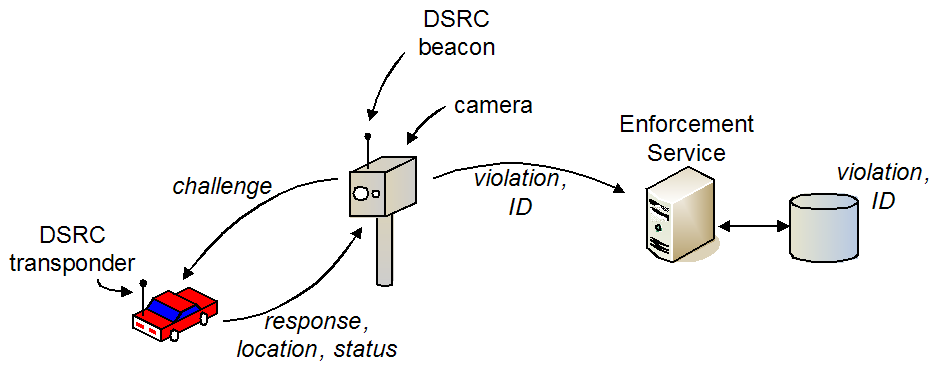
To detect drivers who have switched off their OBUs requires some form of road-side cross-checks. These could either be with automatic number-plate recognition cameras, or RF beacons. The details differ, but these challenge the OBU to prove it is operating honestly.
The response to challenge is a yes or no, and is managed by the trusted cryptographic engine within the OBU. Privacy is maintained: journey history is not leaked by the challenge.
Challenge from Road-Side Beacon
Useful Links...
Congestion and road pricing Department for Transport's road pricing website.
Road Pricing Feasibility Study Department for Transport's investigation into road pricing.
Road Pricing Demonstrations Project Explains the Department for Transport Demonstrations Project. Includes Invitation to Tender documents.
The Eddington Report Executive Summary
Intelligent Transport Systems and Services the Technology Strategy Board program and competition document
Talks presented at the Privacy-Friendly Fraud Detection and Payment Enforcement in Road Charging Schemes conference run for the DfT by the Enterprise Privacy Group. See the paper on the German road pricing scheme.
Privacy Impact Assessment Handbook from the Information Commissioner's Office
Privacy by Design Report from the Information Commissioner's Office
Privacy Engineering Whitepaper from the Cyber Security KTN Privacy Special Interest Group
Road Pricing 2008 conference - includes a section on the DfT's Road Pricing Demonstrations Project.